From estimates to accuracy
Helping critically ill patients get the nutrition they need
Thanks to research funding from Charlies Foundation for Research, critical care dietitian and researcher, Bianca Mammana, has helped bring a more personalised approach to nutrition for critically ill patients at Sir Charles Gairdner Hospital.
When someone is critically ill and receiving care in an intensive care unit (ICU), every part of their treatment needs to be carefully considered. That includes something we all need to survive, nutrition.
But for critically ill patients, working out exactly how much energy their body needs is far more complex than simply calculating their weight and applying a standard formula. Patient’s needs can change rapidly as their body responds to infection, illness and treatment. For Bianca Mammana, an experienced critical care dietitian at Sir Charles Gairdner Hospital, this flagged an issue in need of attention.
“I’ve spent much of my career caring for some of the sickest patients in the hospital and looking for ways to optimise their nutrition.” Says Bianca, “What struck me was that, despite the highly precise and personalised care provided in intensive care, nutrition was often based on estimates rather than what a patient actually needed.”
The problem is that an estimate isn't always accurate, which led Bianca to investigate how there could be a better way to measure what the body needs.
Providing too little nutrition to someone who is critically ill can contribute to muscle loss, poor wound healing, infections and slower recovery. But providing too much can also cause problems, including metabolic complications and difficulties during recovery.
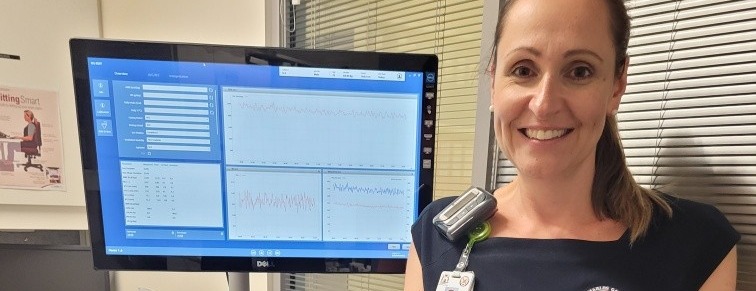
The gold-standard way to determine how much energy a critically ill person's body is using is a technology called indirect calorimetry. In simple terms, it measures how much energy the body is actually using by analysing the gases a patient breathes in and out.
At the time Bianca began her research, this technology wasn't routinely available in Intensive Care because the equipment was expensive and not always practical to use.
Determined to make a difference, Bianca set out to investigate whether measuring patients' actual energy needs could provide a better approach.
Through collaboration with Edith Cowan University, she gained access to an indirect calorimetry device for research and, together with a dedicated research team, began a feasibility study at the Sir Charles Gairdner Hospital ICU.
Measuring instead of guessing
The study compared patients' measured energy needs with the amounts predicted using commonly used formulas but the results showed considerable differences between the estimates and what patients' bodies were actually using. The research also looked at how energy requirements changed in relation to infection and the severity of illness and reinforced that a critically ill patient's energy needs are not static.
As infection, inflammation and the severity of illness began to resolve, patients' energy requirements tended to increase.
This highlighted the importance of regularly reassessing nutritional needs rather than assuming the same calculation will remain accurate throughout an ICU stay. The research also identified which commonly used predictive methods appeared to be the most accurate when direct measurement wasn't possible.
From research to practice
Perhaps the most exciting outcome of the project has been the research turning into action. As newer indirect calorimetry technology became faster, easier to use and more affordable, Bianca and her colleagues were able to advocate for its introduction into clinical practice at Sir Charles Gairdner Hospital ICU with the technology now routinely used in suitable critically ill patients as part of standard care.
For patients and their families, the difference may seem simple, the right nutrition, at the right time, for the individual patient. But in Intensive Care, that precision can matter enormously to someone’s healing journey.
Research that keeps moving forward
The project has also created opportunities well beyond the initial study. Bianca has presented the research at state and national conferences, including the Australian and New Zealand Intensive Care Society Perth Roadshow and the Australian Society of Parenteral and Enteral Nutrition national conference.
She has completed a manuscript for journal submission, with a second paper underway, and the findings have contributed to clinical discussions and guidelines around nutritional care.
Just as importantly, the project has helped Bianca develop her expertise as both a clinician and researcher. For an early-career researcher balancing research with a demanding clinical workload, this is significant.
Charlies Foundation for Research's Bright Ideas Grant provided dedicated research back-fill time, allowing Bianca to complete the manuscript, share the findings and progress the project beyond the original study.
For Bianca, the value of research funding is not simply measured by publications or conference presentations. It is measured by what happens to patients.
“This project has always been about identifying a gap between evidence and clinical practice, finding a way to investigate it, and ultimately helping critically ill patients receive nutrition that is better tailored to their individual needs.”
The journey from a question raised at the bedside, to research, to evidence, and finally to a change in clinical practice, is exactly what research funding can make possible.
And it demonstrates the power of giving to medical research.
Your support can help researchers ask the questions that matter, find better answers and turn those discoveries into improvements in patient care.